miercuri, 7 decembrie 2022

AI Generated Code: an Aid or a Threat to Software Developers?

During recent years, many low-code/no-code solutions gained popularity as alternatives to hiring software developers for creating simple websites, like e-commerce platforms for businesses. In this article we are talking about the latest trend in code generation, OpenAI's GPT chatbot.

GPT-3, (which stands for Generative Pretrained Transformer 3) is a language model that has the ability to generate human-like text. GPT-3 is trained on a large dataset of text and can generate text that is coherent and similar to human writing. Since the public launch of GPT, tech enthusiasts have explored its capabilities of code generation and found that it can create complex pieces of code. This raises the question: can GPT-3 replace programmers? The short answer is no. While GPT-3 can generate text that resembles code, it is not capable of generating functional, efficient, or reliable code. For proving this point, I decided to test the generator myself on a few practical problems, and analyze the results. I selected some problems from books and contests for beginners in competitive programming. At first I was impressed by its capacity to come up with custom implementations in my languages of choice for variations of classic algorithms. For example, it succeeded in implementing a functional React component for multiplying matrices provided by the user, or a C++ function for applying Dijkstra's algorithm, assuming that the cost of a path is the maximum of the edges instead of their sum. However, when the problem did not only require an adaptation of a classic algorithm, but rather expected an original approach, the AI failed. This is because generating code requires a deep understanding of the problem that is being solved and the context in which the code will be used, which are difficult for AI algorithms to replicate. In addition to this, writing code is more than just stringing together lines of code – it requires problem-solving, critical thinking, and creativity. As a conclusion, I think that, while GPT-3 or similar solutions may be able to assist programmers in certain tasks, they cannot replace them entirely. Programming will continue to be a critical skill for developers, and the human touch will remain an essential element of successful code development. GPT-3's code generating abilities are limited, and it cannot replace human programmers.

joi, 24 noiembrie 2022

ML enhancing Cloud Security via Microsoft Sentinel

 As technology advances, cloud solutions are becoming more and more common, and with that the need for better solutions for cloud cybersecurity is also increasing. In this aspect, machine learning has helped by reducing the costs and the response time required for managing these threats.

A prime example of this would be Microsoft Sentinel. Sentinel is a scalable, cloud-native solution that delivers intelligent security analytics and threat intelligence across the enterprise. With Microsoft Sentinel, you get a single solution for attack detection, threat visibility, proactive hunting, and threat response.


Sentinel comes with a set of functionalities such as an easy way to gather the data across the enterprise. You can collect the data at cloud scale, across all users and combine it with security information in order to find threats. Almost all the solutions provided by Microsoft are connected via data connectors that are used for real-time integration.


Sentinel uses highly scalable machine learning algorithms to detect threats and reduce the number of false positives. At Ignite 2021, Microsoft introduced Fusion analytics which, based on ML, constantly learn from past attacks, apply analysis and find threats that wouldn’t be possible to find automatically. Besides that, there have been UEBA (User and Event Behavior Analytics) models to better identify threats based on behavioral anomalies. 


To understand the scope of an attack, Sentinel is using AI-based investigation and also provides a way to automate it by building hunting queries and Azure Notebooks. The built-in queries are one of the best features that Microsoft Sentinel provides because it allows you to “hunt” for security threats across your data, even before an alert is triggered.


Talking about automation, you can build playbooks, a cloud service that helps you schedule, automate, and orchestrate tasks and workflows across systems throughout the enterprise, or use the ones that are already provided by Microsoft to solve repetitive tasks and to respond to threats quickly.


Sources: - https://learn.microsoft.com/en-us/azure/sentinel/

                - https://techcommunity.microsoft.com/t5/microsoft-sentinel-blog/microsoft-sentinel-introduces-enhancements-in-machine-learning/ba-p/2897871

miercuri, 23 noiembrie 2022

Automated Machine Learning and the Future of Data Science


Automated Machine Learning tools

What is Automated Machine Learning?


Most of you probably already know what AutoML is, or at least heard of it. Automated Machine Learning is a tool built by Google to automate the full machine learning pipeline. But Google is not the only one to have developed such a tool, Microsoft, Oracle and Amazon, all have their own implementations in the cloud.

Automated Machine Learning tools are build to perform a deep and wide search over a vast number of models and hyperparameters to find the best model and the best feature engineering for the problem. Besides the automation of a large part of Machine Learning projects, it is pretty easy to get started, being somewhat user-friendly, especially for people with software or cloud experience who want to run their models at scale.

Due to this and a plethora of low-code/no-code tools are taking the industry by storm. There are more than enough articles claiming that Automated Machine Learning will replace Data Scientists. But it might not be so, at least for the time being.


What Does Automated Machine Learning Do?

AutoML automates the entire machine learning workflow.

Automated Machine Learning is preferred to be done in cloud infrastructures like Google Cloud, Azure Machine Learning or Amazon SageMaker. It's purpose is to replace all the manual parts of tuning and model experimentation done by today's Data Scientists through searching for optimal hyperparameters and models for modeling tasks. Even the iterative piece is handled by AutoML, it's main function is to optimize evaluation metric so they will keep iterating until the best results are achieved.


Once the model has been trained, it can be easily deployed into a Production instance on the cloud, where model monitoring checks are set up to review such as Precision-Recall curves, Feature Importance and more.

The cloud platforms also have specific Deep Learning products with AutoML for use cases such as Vision (Object Detection), NLP, Time Series (Forecasting), and many more.


The future of Data Science and of Data Scientists

By the look of things, it seems that domain knowledge will rule the future for Data Scientists. Understanding the relationship between inputs and outputs in human-interpretable ways, having the skills to communicate this knowledge is the most important input to predictive modeling. In order to build better model input, the business problem that the model is being applied to, must be understood by specialists. 

It is believed that the Data Scientist of the future will spend most of his time designing experiments, confirming hypothesis, embedding themselves close to the business, and writing SQL to build features to improve model accuracy.

So, in the end, I believe that the Data Scientist will not be replaced but the profession itself will undergo some major changes in that which constitutes it's role, since AutoML cannot handle the interpretation of models to business leaders, together with recommendations of what actions to take and so on. 


Bibliography

  • https://aliz.ai/en/blog/automl-an-introduction-to-get-you-started/
  • https://medium.com/analytics-vidhya/an-introduction-to-automl-8356b6ceb091
  • https://docs.google.com/presentation/d/1dp9-F3lGInr_H8sTFEOVKBNCPGkplk7bb99kvpkJdmQ/htmlpresent
  • https://fortune.com/education/business/articles/2022/05/26/the-value-of-a-data-science-degree-as-told-by-microsofts-chief-data-scientist/

marți, 22 noiembrie 2022

Digital olfaction


Image generated using Dall-E 2 ("artificial intelligence smelling a flower")


In the world of computers, the ability to smell has been made possible through artificial intelligence. This may sound like a futuristic concept, but it’s actually being used today in a variety of industries, from food production to healthcare.

Digital “noses” work by detecting and identifying chemicals in the air. This information is then analyzed by algorithms that have been specifically designed to interpret the data. The use of artificial intelligence in this way has a number of advantages. Machines don’t get tired and they can be programmed to ignore certain smells that might otherwise interfere with their ability to identify other, more important smells, making them much more accurate than the human nose. What’s more, digital noses can be used to detect very faint smells that would be undetectable to the human nose.

Digital olfaction can be extremely helpful in a number of different industries. For example, digital noses are being used in the food industry to detect early signs of food spoilage.
Aryballe is a leading provider of digital olfaction technology. Aryballe has developed a range of sensors that can be used to detect a wide variety of odors, including those associated with spoilage. This technology is helping food companies to improve food safety and quality control.

One of the most promising applications of digital olfaction is in the early detection of cancer. Cancerous cells produce unique volatile organic compounds (VOCs) that can be detected by sensors. In one study, digital olfaction was able to correctly identify the VOCs associated with lung cancer with high accuracy.

Digital olfaction has the potential to revolutionise the way we diagnose and treat patients with Parkinson’s disease (PD). Currently, the gold standard for diagnosing PD is through clinical assessment, which can be unreliable. There is no definitive diagnostic test for PD, and the current methods for diagnosis are often invasive, expensive, and/or require specialised equipment. Digital olfaction has the potential to improve the accuracy of PD diagnosis and to provide a more convenient and less invasive way to test for PD. This technology could also be used to monitor PD progression and to evaluate the efficacy of PD treatments.

This technology is still in its early stages, but it shows a lot of promise. In the future, it’s likely that digital noses will become even more widespread and play an important role in a variety of different industries.

Bibliography:


joi, 17 noiembrie 2022

AI Generated Prize Winning Picture

    A few weeks ago, there was a heated debate regarding the implications of AI in the process of art making. Jason M. Allen used one such generated piece of art to register into the digital art category of the Fine Arts competition, at Colorado State Fair, where he also won the first prize. This raised several complaints from other artists, some of them eventually accusing him of cheating, yet Jason M. Allen did not break any of the rules as the entry was registered with the title “Jason M. Allen via Midjourney”, and therefore he kept the prize.

    In simple terms, the application works by entering some  words in a textbox, describing what the artist would like to create, and then the AI that was trained on a dataset of other artist's works (both copyrighted and not) would produce a set of images.

    The image that won the Fine Arts competition is the one presented above, and has been generated using Midjourney. Midjourney is one of the best tools available and at the moment any person can try it on their Discord server. Here is a link presenting some of the best work created by the community: https://www.midjourney.com/showcase/.

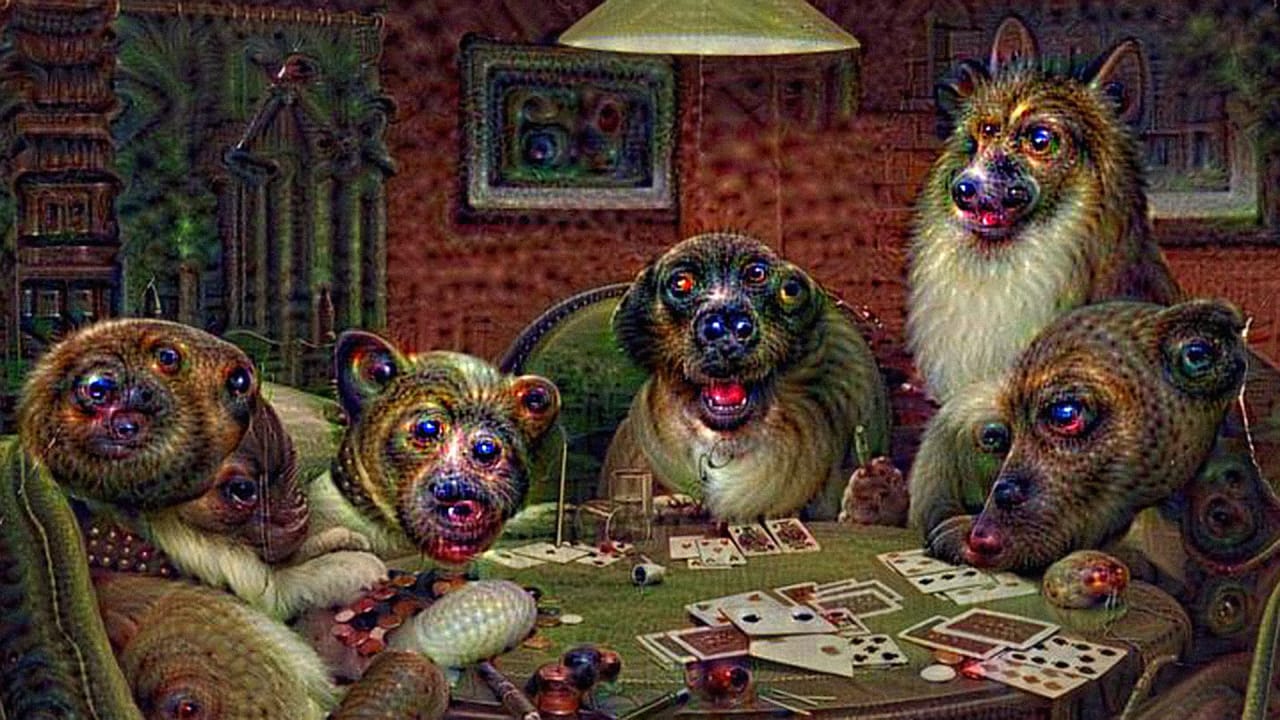
    One of the biggest breakthroughs in A.I. generated art happened in 2015, when Alexander Mordvintsev (a Google engineer) created DeepDream, a program that uses neural networks to create an image similar with what one would see when ingesting LSD. The following image represents the LSD-like experience:


    Other memorable mentions of such applications would be OpenAI’s DALL-E-2 and Stable Diffusion, which similarly can create realistic images and art from a description presented in natural language.


    Regarding the moral implications of these great algorithms, do you think this represents the end of visual artists? We definitely think not, as it would rather be a super powerful tool that allows artists to express their creativity, and to brainstorm ideas that can then bloom into even more impressive pieces of art.


    Bibliography:

joi, 10 noiembrie 2022


Body fat predictions


                 Introduction

                    Machine learning is now used to create new measurements that help corelate 
body fat with cardiometabolic diseases.
                    The dataset used for the development of the convolutional neural networks (CNNs)
consists of MRI imaging data collected from 40,032 participants from UK.
                    MRI or magnetic resonance imaging is a noninvasive way to examine organs, tissues
and the skeletal system of a person. In short terms the procedure produces high-resolution
images of the inside of the body and this allows doctors to have a clearer view of
what is happening.
                    In order to train the CNNs, the specialists have split the data in two separated parts.
The first part which was used for training consisted in 9,041 samples and the
second part of the dataset (30,991) was used for testing.


                    The samples used for training were already quantified in different measurements, for
example:
            - visceral adipose tissue (VAT)
            - abdominal subcutaneous adipose tissue (ASAT)
            - gluteofemoral adipose tissue (GFAT)
                    After training, the CNNs were used to quantify the remaining data from the other participants.By doing this the scientists were able to derive new metrics which were fully independent
of BMI (Body Mass Index).
                    The new metrics are called:
            - VAT adjusted for BMI (VATadjBMI)
            - ASAT adjusted for BMI (ASATadjBMI)
            - GFAT adjusted for BMI (GFATadjBMI)


                    The results of the CNNs showed a near-perfect estimation for VAT, ASAT and GFAT.
                    By taking the presence of type 2 diabetes and associating it with the new metrics, 
the following results were obtained:
            - VATadjBMI showed a significantly increased risk with a OR/SD (odds ratio per standard deviation increase) of 1.49 and 95% CI (confidance interval)
            - ASATadjBMI was largely neutral with 1.08 OR/SD and 95% CI
            - GFATadjBMI conferred protection with 0.75 OR/SD and 95% CI


                    Bibliography

https://www.medrxiv.org/content/10.1101/2021.05.07.21256854v2


Application of Machine Learning 

in Electromagnetics


                Abstract

                 As an integral part of the electromagnetic system, antennas are becoming more advanced and versatile than ever before, thus making it necessary to adopt new techniques to enhance their performance. Machine Learning (ML), a branch of artificial intelligence, which is a method of data analysis that automates analytical model building with minimal human intervention. The potential of solving unpredictable and non-linear complex challenges is attracting researchers in the field of electromagnetics, especially in antenna and antenna-based systems. Although the accuracy of Machine Learning algorithms depends on the availability of sufficient data and expert handling of the model, it is steadily becoming the desired solution when the aim is for a cost-efficient and without excessive time consumption solution. 

                In this project we will be presenting an overview of machine learning and its applications in electromagnetics. Moreover, we will discuss what types of antennas can be used in different places based on the electromagnetic reading from that area, by using intelligent algorithms for the antenna design.


                 Introduction

                In Timis county, a multitude of measurements related to electromagnetic fields were performed. The measurements took place in all the big cities and in the surrounding villages and communes. The main points of interest were hospitals, schools, churches, GSM antennas and other public buildings and large intersections. The factors that could influence the results are the temperature, the weather and the time when the measurements took place, based on the number of dwellings present at these locations and the devices used.

                          Figure 1. Applications of Machine Learning in the field of electromagnetics.

                    The objective of the project covers the "Antenna positioning and direction estimation" based on the measurements noted from different parts of the city. The places where high concentrations of electromagnetic fields are detected, can be used to determine whether it is an appropriate place to install an antenna and it can also be used to determine if in the direction in which the antenna is pointed has disruption points.

                    How can Machine Learning help in electromagnetics? Electromagnetics in today's world is everywhere, in every device that consumes electricity. If a current passes through a wire, it will generate an electromagnetic field. Considering this, we want to generate electromagnetic fields when we want to communicate over Wi-Fi, Bluetooth or other types of wireless transmissions. This type of electromagnetic Wi-Fi communication has a drawback, it is prone to interferences. A good example would be if we have a lot of electronics in a place where we want to use our mobile phone to connect to a Wi-Fi network. In this case, the data can be corrupted, leading to loss of connection or other unintended behavior. Another problem is how can we separate multiple mobile phones by interfering with each other.

                    Machine learning can help by learning the interference pattern and canceling out those patterns. In this case, the error rate can be reduced by as much as 75-90%, yielding to a better data transmission and less error correcting work. By using different kind of models, we can adapt our antenna layout in ways that can optimize communication in a tight area, if we want a focused communication, like e a beam.

                    By using machine learning we can create a model to work more reliably in harsh condition, like rain, snow, or other interfering factors. Another way we can optimize the electromagnetic situation by using learning algorithms is by using less expensive antennas, because we can compensate with data predictions leading to a cost reduction solution.


Bibliography:

- https://www.mdpi.com/2079-9292/10/22/2752/pdf

Disease Symptom Prediction

Introduction: Machine learning is programming computers to optimize a performance using example data or past data. The development and e...